


The stock market has produced extraordinary wealth over the last century. Yet while millions participate, only a select few investors have consistently outperformed the broader market across decades. These individuals are not just wealthy they are studied, quoted, and emulated because their approaches stand the test of time.
In this expanded guide, we take a deeper look at the best stock market investors, their philosophies, measurable performance differences, portfolio allocation styles, risk management frameworks, and the lessons modern investors can apply in 2026 and beyond.
This article is designed to provide both strategic insight and practical value whether you’re a beginner investor or someone looking to refine your approach.
Table of Contents
What Makes Someone One of the Best Stock Market Investors?
Before analyzing specific individuals, it’s important to define what separates great investors from average ones.
A top-tier investor typically demonstrates:
- Market outperformance over multiple decades
- Capital preservation during downturns
- A repeatable investment philosophy
- Risk management discipline
- Adaptability across economic cycles
- Influence on investment theory
Sustained performance is what truly matters. One strong year does not define greatness consistency over 20–50 years does.
The Most Influential and Best Stock Market Investors of All Time
Below is a deeper exploration of legendary investors whose performance and philosophies continue to shape modern investing.
1. Warren Buffett – The Long-Term Value Champion
Often considered the greatest investor in history, Warren Buffett transformed Berkshire Hathaway from a struggling textile business into a global investment powerhouse.
Performance Overview
| Metric | Buffett | S&P 500 |
| Average Annual Return (1965–Present) | ~19–20% | ~10–11% |
| $10,000 Invested in 1965 | Hundreds of Millions | ~Millions |
| Primary Strategy | Value + Quality | Broad Index |
The power of compounding explains Buffett’s success. A 9–10% annual difference over 50+ years creates exponential wealth divergence.
Buffett’s Core Investment Framework
- Buy high-quality companies with durable competitive advantages
- Focus on intrinsic value rather than market price
- Invest in understandable businesses
- Hold for decades, not months
- Avoid unnecessary diversification
Buffett evolved from buying “cheap stocks” (inspired by Benjamin Graham) to buying “wonderful companies at fair prices.”
2. Peter Lynch – Growth Investing with Research Discipline
Peter Lynch managed Fidelity’s Magellan Fund from 1977 to 1990 and delivered approximately 29% annual returns — one of the best mutual fund performances in history.
Growth Categories Identified by Lynch
- Slow growers
- Stalwarts
- Fast growers
- Cyclicals
- Asset plays
- Turnarounds
His philosophy emphasized research-driven conviction.
Key Principles
- Invest in businesses you understand
- Look for earnings growth consistency
- Evaluate debt levels carefully
- Identify early-stage expansion potential
Lynch proved that disciplined growth investing can outperform even during volatile market cycles.
3. George Soros – The Macro Strategist
George Soros is known for his aggressive macroeconomic positioning.
His most famous trade: shorting the British pound in 1992, generating over $1 billion in profit in a single day.
Soros’ Strategic Edge
- Focus on global economic imbalances
- Identify currency misalignments
- Act decisively with high conviction
- Adapt rapidly to changing market conditions
Unlike value investors, Soros frequently adjusts positions based on macro developments.
4. Benjamin Graham – The Father of Value Investing
Benjamin Graham laid the intellectual foundation of value investing.
His book, The Intelligent Investor, remains one of the most cited investment books globally.
Graham’s Core Concepts
- Intrinsic value
- Margin of safety
- Defensive vs. enterprising investing
- Emotional discipline
His teachings influenced Warren Buffett and generations of investors.
5. Joel Greenblatt – Quantitative Value Discipline
Greenblatt introduced the “Magic Formula,” focusing on:
- High return on capital
- Attractive earnings yield
His hedge fund reportedly generated ~30% annualized returns over multiple years by systematically ranking companies.
6. Charlie Munger – Mental Models and Rational Thinking
Charlie Munger, Buffett’s longtime partner, emphasized multi-disciplinary thinking.
His Contribution
- Use mental models from economics, psychology, mathematics
- Avoid cognitive biases
- Think long-term and rationally
Munger’s influence helped shape Berkshire Hathaway’s capital allocation philosophy.
Leading Indian Stock Market Investors
India has produced influential market legends who built significant wealth in domestic equities.
Rakesh Jhunjhunwala
Known as the “Big Bull of India,” he turned modest capital into multi-billion-rupee wealth through high-conviction long-term bets.
Radhakishan Damani
Founder of DMart and a respected value investor known for disciplined capital deployment.
Vijay Kedia
Identified high-growth small-cap companies with scalable business models.
Strategy Breakdown: How the Best Investors Allocate Capital
Below is a conceptual strategy allocation model inspired by legendary investors.
Example Portfolio Allocation (Value-Oriented Model)
| Asset Type | Allocation |
| Large-cap Quality Stocks | 40% |
| Mid-cap Growth Stocks | 25% |
| Small-cap Opportunities | 15% |
| Cash Reserves | 10% |
| Defensive Assets | 10% |
Traits of successful stock investors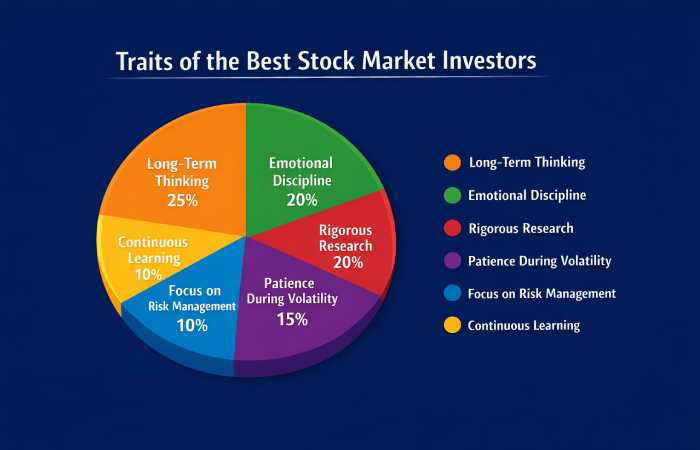
Performance Gap: Legendary Investors vs Market Index
The difference between 10% and 20% annual returns may seem small, but compounding creates massive long-term divergence.
30-Year Wealth Comparison (Starting with $10,000)
| Annual Return | Final Value |
| 8% | $100,626 |
| 10% | $174,494 |
| 15% | $662,117 |
| 20% | $2,373,763 |
| 25% | $8,675,000+ |
This illustrates why sustained outperformance defines the best stock market investors.
Psychological Traits of Top Investors
Performance alone does not create legendary status. Behavioral discipline plays a crucial role.
Common traits include:
- Patience during volatility
- Independent thinking
- Emotional control
- Strong risk assessment
- Data-driven decision making
- Willingness to admit mistakes
Markets reward discipline more than intelligence.
Risk Management Techniques Used by Top Investors
| Risk Method | Purpose |
| Margin of Safety | Protect against valuation errors |
| Diversification | Reduce concentration risk |
| Cash Reserves | Seize opportunities during crashes |
| Long-Term Holding | Avoid overtrading losses |
| Fundamental Analysis | Reduce speculative exposure |
Risk control often matters more than aggressive gains.
Common Traits of the Best Stock Market Investors
While the best stock market investors may follow different strategies value, growth, macro, or quantitative their long-term success is rarely accidental. Across decades and market cycles, a consistent set of psychological and strategic traits separates elite investors from average market participants.
Below is a deeper exploration of the core characteristics that define legendary investors like Warren Buffett, Peter Lynch, Benjamin Graham, George Soros, and Charlie Munger.
Explore More Wealth Building & Investing Topics
Common Mistakes That Separate Average Investors from the Best
- Chasing momentum without fundamentals
- Panic selling during downturns
- Overleveraging portfolios
- Ignoring valuation metrics
- Following social media hype
The best investors avoid emotional reactions and focus on data.
Key Lessons for Modern Investors in 2026
- Think long-term
- Focus on business quality
- Understand financial statements
- Avoid speculation-driven decisions
- Learn continuously
- Embrace compounding
Technology has changed trading speed but investing principles remain timeless.
Final Analysis: Why Studying the Best Stock Market Investors Matters
The stories of Warren Buffett, Peter Lynch, George Soros, Benjamin Graham, and leading Indian investors demonstrate that:
- Markets reward discipline
- Strategy consistency beats short-term excitement
- Compounding is the most powerful force in finance
- Emotional intelligence is as important as analytical ability
You do not need insider access or complex algorithms to succeed. What you need is a sound framework, patience, and the ability to learn from proven masters.
Stock market investing is not about overnight success. It is about applying rational principles consistently across decades.